Coherent inelastic single-phonon scattering from a powder sample -- Aluminum
The scattering intensity is given by $$ \begin{aligned} {\left(\frac{d^2\sigma}{d\Omega dE_f}\right)}_{inc\pm 1} = & \frac{\sigma_{coh}}{4\pi} \frac{k_f}{k_i} \frac{(2\pi)^3}{v_0} \exp(-2W) \\ & \times \sum_s \sum_{\mathbf{\tau}} \frac{ \hbar^2 ( \mathbf{Q} \cdot \mathbf{e}_s )^2 }{2M\;E_s} \frac{1}{2} \left\{ \coth\left(\frac{\hbar \omega}{2k_B T}\right) \pm 1 \right\} \delta(E- E_s) \; \delta(\mathbf{Q} - \mathbf{q} - \mathbf{\tau}) \end{aligned} $$ where $\mathbf{e}_s$ is the polarization of the phonon mode, $E_s$ is the energy of the phonon mode, $\mathbf{\tau}$ is a reciprocal lattice vector. The total cross section for a phonon mode of energy $E$ at $\mathbf{Q}$ can be deduced as $$ \sigma_{\mathbf{Q}} = \frac{\sigma_{coh}}{4\pi} \frac{k_f}{k_i} \frac{\left( 2\pi \right)^3}{v_0} \exp(-2W) \frac{\hbar^2 ({\mathbf{Q}}\cdot {\mathbf{e}})^2}{2M E} \frac{1}{2} \left\{ coth\left(\frac{\hbar \omega}{2k_B T}\right) \pm 1 \right \} \frac{1}{2 k_i k_f Q} $$ The main input for this kernel is the energies and polarization vectors of phonon modes in a brillouin zone.MCViNE simulation results
Coherent scattering give the scattering spectra more features.
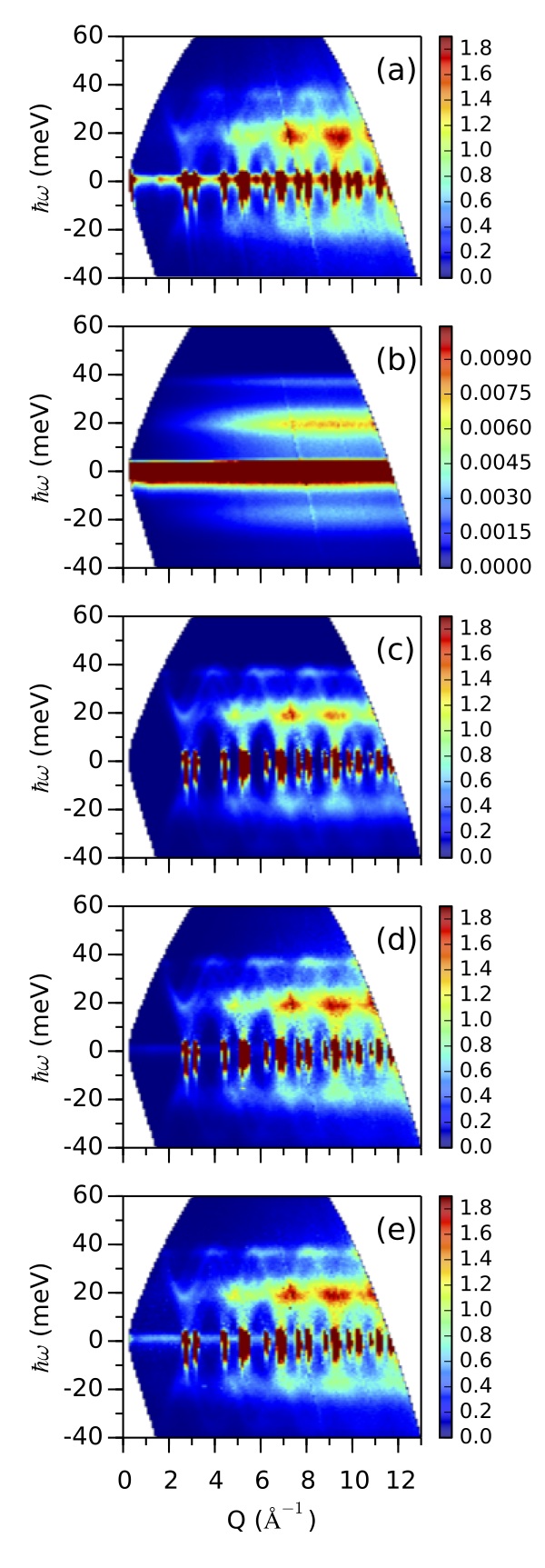 The experimental result is given in panel (a) and panels
(b)-(e) show simulated data.
In (b) only the incoherent elastic and incoherent
single phonon scattering are included.
This is the only plot
with different, much lower maximum intensity -- it is scaled by the ratio of
incoherent/coherent cross sections of aluminum, otherwise the
intensities in this plot are barely visible.
In (c) only the coherent elastic (powder diffraction) and the coherent
single-phonon inelastic scattering are included.
In (d), all of the
kernels in (b) and (c) with the addition of a multi-phonon kernel
using the incoherent approximation.
In (e), all of the kernels in (d) are
used with multiple scattering turned on.
Comparison of (b) and
(c) shows that coherent scattering gives rise to more features such as
diffraction peaks and phonon dispersions.
It is evident from
comparing (c) and (d) that multiphonon scattering increases in
intensity at higher Q.
The most obvious difference in (d) and (e) is
in the elastic line which shows that multiple scattering seems to
contribute similarly to incoherent elastic scattering.
The elastic line in (a) and (e) seems to show that the sample used in the
experiment may contain traces of an additional phase, most likely from
a surface layer of Al$_2$O$_3$.
The experimental result is given in panel (a) and panels
(b)-(e) show simulated data.
In (b) only the incoherent elastic and incoherent
single phonon scattering are included.
This is the only plot
with different, much lower maximum intensity -- it is scaled by the ratio of
incoherent/coherent cross sections of aluminum, otherwise the
intensities in this plot are barely visible.
In (c) only the coherent elastic (powder diffraction) and the coherent
single-phonon inelastic scattering are included.
In (d), all of the
kernels in (b) and (c) with the addition of a multi-phonon kernel
using the incoherent approximation.
In (e), all of the kernels in (d) are
used with multiple scattering turned on.
Comparison of (b) and
(c) shows that coherent scattering gives rise to more features such as
diffraction peaks and phonon dispersions.
It is evident from
comparing (c) and (d) that multiphonon scattering increases in
intensity at higher Q.
The most obvious difference in (d) and (e) is
in the elastic line which shows that multiple scattering seems to
contribute similarly to incoherent elastic scattering.
The elastic line in (a) and (e) seems to show that the sample used in the
experiment may contain traces of an additional phase, most likely from
a surface layer of Al$_2$O$_3$.